


I spent my early career as a deck officer in the merchant fleet, and one lesson from those years has stayed with me through almost two decades of running a crewing company: a ship is only as good as the people on board. For offshore support vessel operators today, the scarcest resource is often not the vessel but the people who run it. Charter rates, fleet utilisation and newbuilding plans dominate the headlines, yet ask any marine superintendent what keeps them awake and the answer is usually closer to home: who will relieve the Chief Officer on the PSV next month, and does he have enough DP hours to keep his certificate valid?
A platform supply vessel, an anchor handler or a construction support vessel on charter earns nothing while it waits for a qualified relief. Every crew change that slips puts pressure on the next one, stretches contracts beyond what seafarers agreed to, and eventually shows up in client audits and incident reports. In a market where skilled offshore crews are in demand across oil and gas, offshore wind and subsea construction, the operators that win are those who treat crewing as a core operational process rather than an administrative afterthought.
In this article I look at why offshore crews are so hard to replace, what a late crew change really costs, and six practices that, in our experience at Marine MAN, help operators staff their vessels faster and keep them staffed.
Why offshore crews are harder to replace
On paper, an officer is an officer. An STCW certificate of competency is the same document whether it was earned on a bulk carrier or an anchor-handling tug. In practice, offshore operations demand a layer of skills that deep-sea trades rarely provide.
Dynamic positioning is the most obvious example. A DP operator needs not only formal training but also a documented amount of sea time on DP vessels to obtain the certificate and then keep it. An officer who spends a year on conventional tonnage can find that his DP qualification has quietly lapsed. That makes the pool of officers who are both certified and current much smaller than the headline number of DP certificates suggests.
Anchor handling is another. Working on deck during anchor handling and towing operations is high-risk work, and the confidence to do it safely comes from experience under a competent master and bosun, not from a classroom. The same applies to cargo operations alongside installations, where everyone on board must understand exclusion zones, weather limits and communication protocols with the platform.
Then there are the clients. Oil majors, national oil companies and offshore contractors audit crew competence before a vessel goes on hire and periodically during the charter. They look at matrices of certificates, sea time on similar vessel types and DP class, and often require a minimum number of years of offshore experience for senior positions. A candidate with an excellent deep-sea record may simply not pass the client's vetting.
The result is that a good officer from the merchant fleet is rarely a like-for-like replacement on an OSV. When a DP-critical position falls vacant at short notice, the real choice is often between a handful of suitable candidates, many of whom are already on board other vessels.
What a late crew change really costs
The direct cost is easy to see. A vessel that cannot sail because a key officer is missing goes off hire or risks penalties under the charter party. Even a single lost day can cost more than a year of crewing fees for that position.
The indirect costs are less visible but just as real. When a relief is late, the officer on board is asked to extend. One extension becomes two, fatigue builds up, and the risk of a mistake grows exactly when the vessel is engaged in demanding operations. The Maritime Labour Convention limits how long a seafarer can serve on board before repatriation, so extensions are not an open-ended solution. Seafarers who are repeatedly extended also tend not to come back, which shrinks the pool even further.
Late changes are expensive in logistics too. Last-minute flights, hotel stays, launch boats and helicopter seats cost far more than a change planned weeks ahead. And every rushed decision raises the chance of sending someone who does not fully meet the client's requirements, which can trigger a fresh round of audits and, in the worst case, a request to replace the person who has just joined.
Practice 1: Plan rotations as a pipeline, not a vacancy
The most effective operators stop thinking about vacancies and start thinking about pipelines. For every DP-critical position on every vessel, they know who is on board now, who relieves him next, and who is the backup if the relief falls through.
That means keeping the relief identified at least one contract ahead, with certificate expiry dates, DP hours, medicals, visas and client-specific training on file. It means tracking when each officer's DP certificate needs revalidation and making sure his next assignment keeps the sea time flowing. And it means agreeing rotation patterns with seafarers early, so that they plan their lives around the schedule instead of taking another job when the call finally comes.
Practice 2: Build a verified talent pool, not a shortlist
Traditional recruitment often runs through a chain: the operator asks a manning agent, who asks a sub-agent, who calls his contacts. By the time a shortlist arrives, days have passed and nobody has a clear view of the wider market. Each link in the chain adds cost and removes transparency.
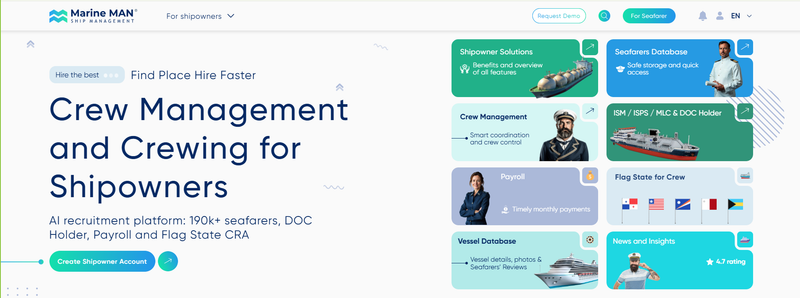
That model is changing, and we see it every day on our own platform. More DP officers, engineers and ratings now look for a job at sea directly online, posting their CVs, certificates and sea-service records where shipowners can see them. For operators, this opens access to candidates who are not tied to a single agency and who can be contacted the same day.
Direct access only works if the information is reliable. Operators should verify certificates against the issuing administrations, check references from previous masters and companies, and confirm DP logbooks before an offer is made. Over time, the candidates who pass these checks form a verified pool that can be called upon whenever a position opens, instead of starting from zero each time.
Practice 3: Measure crew management like any other operational function
Fuel consumption, downtime and maintenance backlogs are measured on every well-run vessel. Crewing deserves the same discipline. Treating crew management as an operational function means agreeing on a small set of indicators and reviewing them as seriously as technical performance.
Useful indicators include time to fill a vacancy by rank, the share of crew changes made on schedule, the number of contract extensions, retention rate by rank and vessel, and the proportion of candidates who pass client vetting at the first attempt. None of these are complicated to track, yet many companies only discover a crewing problem when a vessel is already short-handed.
If crew management is outsourced, the same indicators belong in the service agreement. A provider who reports against them every month gives the operator early warning and a basis for improvement. A provider who only sends invoices does not.
Practice 4: Keep the people you already have
The fastest way to fill a position is never to lose the person in it. Offshore seafarers have options, and they choose employers who respect their time.
Reliable rotations matter more than almost anything else. A seafarer who knows exactly when he will go home, and whose relief turns up on the agreed date, has little reason to look elsewhere. Wages paid on time and in full, clear contract terms and decent conditions on board come next.
Career progression is the third factor. Junior DPOs want a path to senior DPO and then to master; engineers want exposure to modern power and propulsion systems. Operators that plan promotions and training, rather than leaving them to chance, keep their best people and build the next generation of DP-qualified officers from within. Every officer promoted internally is one less vacancy to fill from an overheated market.
Practice 5: Grow your own DP officers
The BIMCO/ICS Seafarer Workforce Report has been warning for years about a shortage of officers, and the offshore sector is named among those where management-level deck officers are hardest to find. Every conference discusses it. Very few companies do anything structural about it.
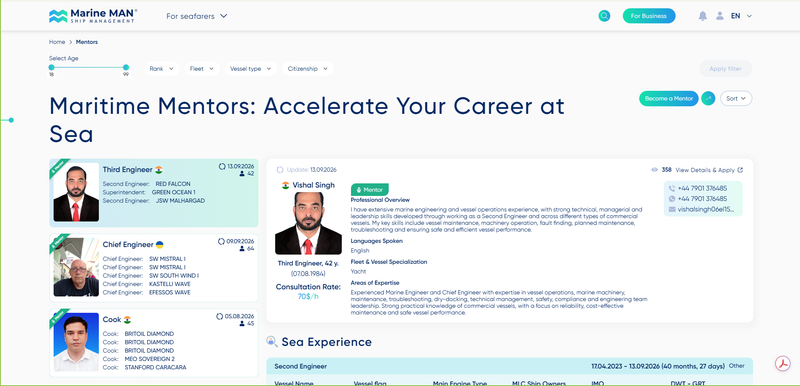
We decided not to wait. JobMarineMan is the first and, as far as I know, still the only crewing platform in the world with a working mentorship programme for seafarers. It is not a plan or a pilot; it is live today. Experienced masters, chief engineers and DP officers apply to become mentors, Marine MAN verifies their sea service and approves them, and from that moment they are visible to every seafarer on the platform. A junior officer picks the mentor whose career looks like the one he wants and contacts him directly; the mentor sets his own terms and agrees them with the seafarer, and we stay out of that conversation. Our job is to make sure every mentor is real, qualified and worth listening to. For an offshore operator, this is a pipeline of the next generation of DP-qualified officers being built today, not a hope that the market will somehow produce them.
Practice 6: Make the first week count
Even the best candidate needs time to become effective on a new vessel. Offshore units differ widely in DP systems, deck equipment and company procedures, and the first days on board decide how quickly a new officer settles in. A structured familiarisation programme, a proper handover from the outgoing officer and a clear contact person ashore reduce the risk of errors and make it more likely that the newcomer will return for the next contract.
What to ask a crew management partner
Many operators outsource part or all of their crewing. The right partner saves time and money; the wrong one simply moves the problem from the operator's desk to a supplier's inbox. A few questions help to tell the difference:
• How many DP-qualified officers and offshore-experienced ratings can you present for our vessel types, and how quickly?
• How do you verify certificates, DP logbooks and references, and can we see the evidence?
• Which countries do you source from, and how do you handle visas and travel for each of them?
• How do you handle wages, social obligations and compliance with the Maritime Labour Convention?
• Which indicators will you report, and how often?
• What happens when a candidate fails client vetting or leaves the vessel early?
These are the questions I would ask if I were on the operator's side of the table. Clear answers to them say more about a provider than any brochure.
How we work at Marine MAN
Marine MAN has worked with shipowners and managers on these questions since 2007. We are an IMO DOC holder and have been certified to ISO 9001:2015 by Bureau Veritas for crew manning and management services since 2017. At any given time, around 750 seafarers serve on board client vessels through Marine MAN, and we source crews from Ukraine, Georgia, India, Sri Lanka, Indonesia, Vietnam and the Philippines.
Our platform JobMarineMan, a seaman jobsite available in 11 languages, holds 200,000 seafarer CVs. It connects shipowners and operators with candidates directly, without a chain of intermediaries, while our team takes over verification, documentation and mobilisation when needed.
In my experience, offshore operators rarely lack candidates on paper. What they lack is time to find the right ones and confidence that the documents are real. Our job is to give them both: direct access to people and a process that checks every certificate before anyone boards.
Conclusion
The offshore fleet cannot grow faster than the crews who run it. DP-qualified officers, experienced anchor-handling crews and engineers who understand modern power systems will remain in demand for years. Operators that plan rotations as pipelines, build verified talent pools, measure crewing performance, grow their own officers through mentorship, onboard new people properly and look after the crews they already have will lose fewer days to late crew changes and find the right people before the gap appears, not after.
About the author
In 2007, a 20-year-old deck officer from Kherson looked at how seafarers found work and decided it was broken. Contracts came by fax. Agencies sat between a captain and his next ship like toll booths, each one taking a cut and adding a week. Pavel Manchenko had been on the other side of that chain, on the bridge, waiting for a call that never came on time. So he founded Marine MAN to fix it.
Nineteen years later, he is still not 40, and the fix has become an ecosystem: recruitment offices in Ukraine, Georgia, India, Sri Lanka, Indonesia, Vietnam and the Philippines under one Marine MAN umbrella, connected on a single platform where AI now makes the first contact with a candidate and a human makes the decision. The numbers behind it: 200,000 seafarer profiles in the database, around 750 seafarers on board client vessels at any moment, and more than 35,000 seafarers who found their job through the platform. He holds a Master's degree from the Kyiv State Academy of Water Transport and is a certified DPA, CSO and MLC 2006 auditor, and he uses all of it: he still consults and mentors shipowners and crews on compliance, and he looks at every crew list the way an inspector would, because he has stood on the deck those inspectors walk.
Then came February 2022. Marine MAN's head office and most of its core staff were in Kherson, the first regional capital in Ukraine to be occupied. Of all the crewing companies in the country, Pavel's was the first to find out what war actually means: colleagues behind the front line, phones that stopped answering, a company that had to be rebuilt piece by piece from wherever people managed to get out. Through all of it, the vessels stayed crewed and the seafarers got paid. That is not a line in a brochure; it is what Pavel's team actually did in 2022.
Ask him how, and the answer is short: "Never retreat, never surrender, and keep faith in God."
He has the energy of a founder half his age and the experience of one twice it. If you want to talk about how your fleet is crewed, talk to Pavel.
Let's discuss cooperation. Want to know how our team can help your business? Contact us: b2b@marineman.eu
Note: The opinions, beliefs, and viewpoints expressed in this article do not necessarily reflect the opinions of offshore-energy.biz.