

Malaysia’s Yinson Production, a subsidiary of Kuala Lumpur-based energy infrastructure and technology company Yinson, is seeking to translate its growing track record in offshore project financing and floating production, storage, and offloading (FPSO) execution into a broader growth platform, with floating liquefied natural gas (FLNG) emerging as a key strategic priority alongside its established FPSO business.
The company's $1.46 billion FPSO Agogo project bond issuance in Angola, regarded as the first transaction of its kind outside Brazil, underscores its efforts to broaden access to institutional capital for offshore infrastructure projects. Beyond this financing milestone, the firm is positioning itself to pursue new opportunities in the floating LNG market, drawing on its established engineering, financing, and operational capabilities.
In an interview with Offshore-Energy.biz, Yinson Production's Chief Executive Officer (CEO) Flemming Guiducci Grønnegaard and Chief Financial Officer (CFO) Markus Wenker talk about the evolution of the company's financing strategy, institutional investor appetite for offshore assets, its FLNG ambitions, and ways in which it is addressing supply chain constraints, project execution risks, and the demands of scaling its business to deliver its next phase of growth.
While Yinson Production views FLNG as a natural extension of its existing business, entering the segment brings additional technical and commercial complexities, particularly in liquefaction technology, specialist expertise, and project financing. The executives explain how the company intends to build the capabilities and partnerships needed to pursue FLNG opportunities, leverage its established institutional investor relationships, and apply its offshore project financing experience to a broader range of infrastructure developments.
For Yinson Production, the strategy extends beyond expanding its asset portfolio, as it involves building on its FPSO track record while developing the financing structures, investor relationships, and execution capabilities needed to support growth across both segments. With FPSOs remaining at the core of its business and FLNG offering an additional avenue for expansion, the company's ability to balance growth with financial discipline and reliable project delivery will be central to its next phase.
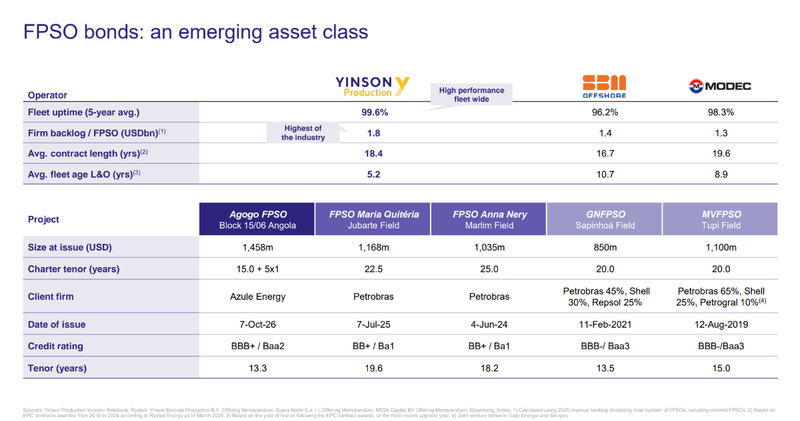
- Flemming, Markus, congrats on setting a massive benchmark with Agogo outside of Brazil. Moving the project bond model outside of Brazil into West Africa introduces a unique structural dynamic. If an asset hits a commissioning or regulatory speed bump, public bondholders lack the quiet, flexible agility of a traditional relationship-bank syndicate. How is Yinson Production insulating its balance sheet against that public market rigidity if regional supply chains or local timelines stretch?
Markus: I think it is important to distinguish between the different stages of an FPSO's lifecycle and the financing instruments best suited to each stage. During construction and commissioning, flexibility is indeed more important, which is why we lean towards bank financing. Once an FPSO is operational and has established a track record, its risk profile changes fundamentally, making project bonds an attractive source of long-term financing.
The Agogo FPSO is a good example. We initially financed the project through a $1.3 billion multi-tranche project financing and only refinanced it through a bond once operational. In other words, bondholders are not exposed to construction or commissioning risk. Of course, operational risks remain to some degree, which is reflected in the bond structure through safeguards such as debt service coverage covenants and reserve accounts.
Bondholders assume the client's credit risk and an element of operational risk, whilst the bond is non-recourse to Yinson Production, meaning repayment relies on the project’s own cash flows rather than Yinson Production’s balance sheet. Furthermore, it matures approximately six months before the firm lease contract expires, providing an additional buffer.
Ultimately, our strategy combines the flexibility of banks during construction with long-term, cost-efficient bond financing once operational, whilst freeing up lending capacity for new projects and providing institutional investors with access to the FPSO asset class.
- Markus, looking at your capital strategy, there is an interesting tension between tapping institutional bond markets that live and die by ESG metrics and scaling assets that extract hydrocarbons for decades. When you structure a record-breaking bond like Agogo, how are your institutional investors treating the carbon intensity curve? Are your institutional investors beginning to price in rigid carbon-intensity milestones for retrofits or power-from-shore integration, or are they strictly focused on baseline project cash flows?
Markus: I wouldn't necessarily consider this a paradox, as sustainability considerations and the need for reliable energy infrastructure are not mutually exclusive. Oil and gas continue to play an essential role in meeting global energy demand, and the energy transition cannot happen overnight.
ESG encompasses not only environmental but also social considerations, including energy security and affordability. The energy transition needs to be environmentally sustainable, economically viable, and socially responsible. We cannot speak for individual investors, who have their own mandates, investment objectives, and requirements, including ESG considerations.
At Yinson Production, we focus on developing and operating our assets responsibly, whilst delivering the reliability and performance expected by our clients and investors. We continuously look for ways to reduce our carbon intensity through technology and innovation. The Agogo FPSO is a good example, incorporating advanced emissions-reduction technologies, including combined-cycle power generation, closed flaring, and a pilot carbon capture system.
For us, these considerations go hand in hand. Our objective is to provide reliable energy infrastructure while continuously improving operational efficiency and reducing emissions. The successful Agogo FPSO project bond issuance demonstrates that institutional investors recognize the investment proposition offered by technologically advanced, long-term FPSO projects.
- Flemming, you have flagged FLNG as a major strategic growth priority, but operationally, shifting an organization from mastering FPSOs to executing complex cryogenic gas liquefaction at sea is a quantum leap in risk profile. Given the historical execution scars the industry has seen with FLNG mega-projects, how are you ensuring that scaling up into gas doesn't stretch Yinson Production’s technical bandwidth or distract your project finance teams right as you are trying to institutionalize this new $1.5 billion project bond template?
Flemming: We don't see FLNG as stretching our capabilities but rather as a natural extension of our existing business. Our core expertise lies in designing, financing, delivering, and operating complex floating energy infrastructure over long asset lives, and we have the capabilities and resources to support this expansion.
We are also not entirely new to gas. Our FPSOs John Agyekum Kufuor and Helang already have significant gas processing capabilities. Whilst FLNG comes with its own technical requirements, particularly around liquefaction, we have extensive experience handling complex offshore hydrocarbon processing, complemented by dedicated expertise and the right technology partners.
Importantly, our expansion into FLNG is driven by market demand rather than opportunism. FPSOs remain our core business, whilst FLNG broadens our opportunities, including potential synergies in integrated developments where FPSOs feed gas to an FLNG facility.
From a financing perspective, we have established the expertise and access to capital required to support large and complex offshore infrastructure projects. Our financing strategy is not built around a single bond template but around structuring the most appropriate financing solution for each project's specific characteristics and risk profile.
- Markus, shifting capital strategy toward FLNG means you aren't just scaling asset size but shifting narrative categories from deepwater oil support to global gas monetization. When institutional investors and state energy partners look at Yinson Production today, they see a masterclass in FPSO execution. How are you evolving your corporate positioning so that the market recognizes your engineering readiness for complex gas infrastructure before you even launch your first FLNG tender?
Markus: As Flemming mentioned, we see FLNG as a natural extension of our existing business. The foundation remains the same: developing, financing, and operating complex offshore energy infrastructure under long-term lease-and-operate contracts with credible counterparties, providing strong visibility on future cash flows.
Our expansion into FLNG allows us to offer both FPSO and FLNG solutions under one roof, creating a differentiated offering for our clients. We are also complementing our existing project execution and operations capabilities with dedicated FLNG expertise, having recruited experienced professionals with extensive track records in the sector.
From a financing perspective, we have established a strong track record in raising capital for large-scale offshore infrastructure, accessing a broad range of funding sources, including banks, private debt and infrastructure funds, and public debt markets through our successful project bond issuances. We bring this financing expertise and access to institutional capital with us into FLNG, whilst recognizing that every project has its own characteristics and requires a tailored financing solution.
Ultimately, we are not starting from scratch. FLNG allows us to leverage the capabilities, financing expertise, and investor relationships we have developed over the years, whilst expanding the range of infrastructure solutions we can offer our clients.
- Markus, having an institutional heavyweight like PIMCO anchor the Agogo bond provides incredible validation, but when a single anchor commands that kind of weight in a pioneering non-Brazil structure, how much influence do they hold over the structural covenants and yield expectations? As you look to scale future project bonds without necessarily relying on the same anchor blueprint, do you feel Yinson Production is now setting the market pricing terms, or are you still largely calibrating to what institutional heavyweights like PIMCO demand?
Markus: Having a leading institutional investor like PIMCO anchor the Agogo FPSO project bond is a tremendous vote of confidence in Yinson Production, our operational capabilities, and the broader FPSO asset class. PIMCO is not a first-time investor in our bonds, having placed significant orders in all our previous bond issuances, so we have built a strong relationship and track record with them over the years.
With Agogo, we followed the same established structuring approach as in our previous project bonds, adapted to the specific characteristics of the project. The conversation therefore focused primarily on aligning pricing expectations to reflect the project’s risk profile and rating, as well as the prevailing market conditions, whilst final pricing was determined through a bookbuilding process.
Whilst we truly value PIMCO’s strong support across all our transactions and in anchoring the Agogo bond, this was not a bilateral transaction, nor do we rely on any single investor. We maintain an active and broad investor outreach and enjoy the confidence of a large and diverse group of institutional investors globally.
- Flemming, the capital side of the equation is clearly locked in with FPSO Agogo, but the real constraint facing top-tier FPSO and FLNG developers globally right now is severe yard congestion, long-lead procurement inflation, and a shortage of specialized maritime engineering talent. With multiple complex units on the horizon, how is Yinson Production securing yard capacity and shielding its construction schedules from the severe supply chain bottlenecks plaguing the broader offshore fabrication market?
Markus: We recognize that yard capacity, supply chain constraints, and the availability of skilled talent are important challenges for the industry, particularly as activity increases. Our approach is to anticipate these challenges and plan proactively.
Importantly, FPSO conversions are less dependent on newbuilding yard capacity, as we primarily work with repair yards for conversion projects, whilst topside modules are fabricated separately at specialized fabrication yards. This provides greater flexibility in project execution.
Over the years, we have built strong relationships with yards, suppliers, and other key partners and continue to expand this network. Our new presence in Shanghai brings us closer to this ecosystem, allowing us to strengthen these relationships and manage projects directly on the ground.
We have also taken specific steps to secure critical resources early. We have already acquired two VLCCs for future conversions and placed advance orders for two sets of gas turbine generators in anticipation of extended delivery times.
Equally important is retaining experienced engineering and project execution talent. Ultimately, our growth ambitions must remain aligned with our own execution capabilities and those of our partners. For us, successful growth is not simply about winning projects but about delivering them reliably and on schedule.
Agogo may ultimately be remembered for more than Yinson Production’s financing milestone, as the project demonstrates how the company's operational expertise, capital structuring capabilities, and institutional investor relationships can support large-scale floating energy infrastructure, while establishing a financing model that could underpin its broader offshore ambitions. The next challenge will be translating that track record into repeatable execution across new markets and more technically demanding assets, particularly as the company expands into FLNG.
By combining its established FPSO capabilities with broader financing expertise and new growth opportunities in FLNG, Yinson Production is seeking to strengthen its position in the global offshore infrastructure market. The company’s ability to balance expansion with financial discipline and reliable project delivery will ultimately determine how far those ambitions translate into sustained growth.
The odds appear to be stacked in Yinson Production's favor, as the global FPSO and FLNG markets are poised for continued growth through 2035, although project delays and investment uncertainty could limit the pace of new developments, according to a new analysis by Intelatus Global Partners. The report from last week, written by Alisa Reiner, identifies 232 planned or on-order floating facilities worldwide scheduled for first production between 2026 and 2035.
While FPSOs dominate the pipeline, accounting for 108 units, there are also 30 FLNG projects, highlighting the growing importance of floating solutions for offshore oil and gas production. From a regional perspective, Latin America remains the leading FPSO market, with 41 projects planned or on order, primarily in Brazil and Guyana.
Africa is also emerging as an important growth region, with 23 FPSO and seven FLNG projects in its pipeline. The recent market trends indicate that FLNG development is gaining momentum as operators increasingly explore floating solutions to monetize offshore and remote gas reserves.
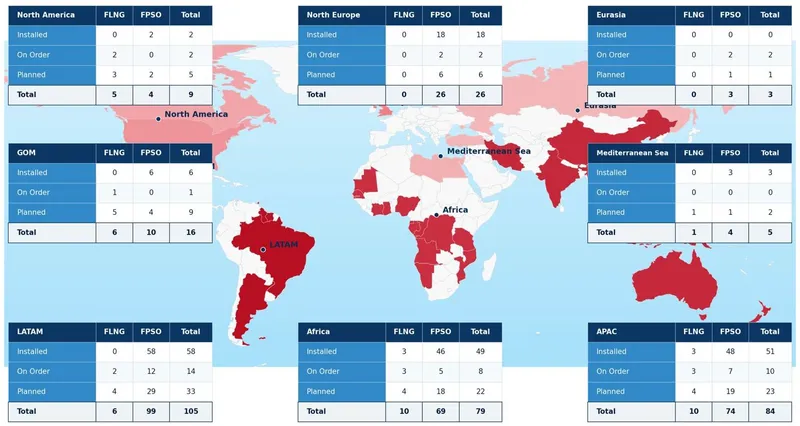
Meanwhile, the broader floating production market faces a more uncertain outlook beyond 2030, with most projects scheduled for that period still at the planning stage. Intelatus highlights significant opportunities for FPSO and FLNG contractors, shipyards, mooring suppliers, and offshore support vessel operators, but the conversion of planned projects into sanctioned developments and executable contracts will be critical to realizing the market's growth potential.